Client: LTOU
Role: Simplifying a complex aviation application process, improving usability, and reducing operational workload through better information architecture and workflow design
Date: Dec. 2025 - May 2026

The PPR form is an application form intended for individuals, organizations, and the Ministry of National Defence for unplanned arrivals at any airport in Lithuania.
The design problem
The existing PPR form was difficult to complete for users unfamiliar with aviation regulations and application requirements. A previously proposed AI-generated solution did not align with business rules, operational processes, or user needs, resulting in several usability issues. Due to time and project constraints, direct end-user research was not conducted; instead, the redesign was based on interviews with airport operations staff who review these applications daily, combined with UX best practices. The goal was to simplify the submission process, reduce errors, and ensure that all required information could be provided more efficiently.
What I designed
Key features

Smart Data Auto-fill & Validation
To reduce manual input and errors, AI recognizes the aircraft registration number and automatically populates details such as type, capacity, and noise classification. The form dynamically adapts based on the selected flight type (N/G/M/X), showing only relevant fields, while real-time validation prevents invalid entries — including arrival times earlier than 24 hours from submission.
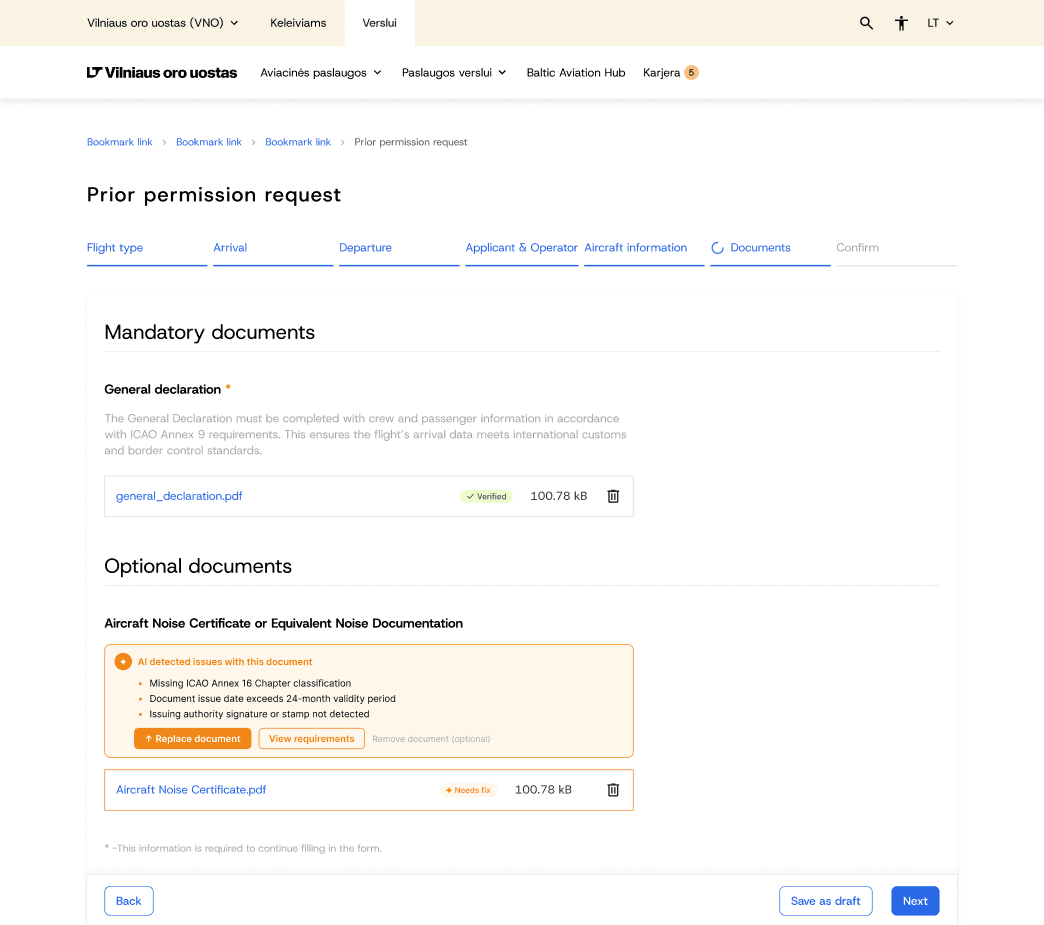
AI Document Checker
Based on LTOU requirements, AI can automatically determine which documents are required according to the flight type and operator country, verify whether uploaded files match the expected document type, and dynamically indicate whether each document is required, optional, or not applicable. Before submission, users are alerted about any missing mandatory documents, helping reduce incomplete applications and speeding up the review process.

Unique Request ID Creation
Each application is assigned a unique Request ID, allowing users to track its status throughout the approval process. Users can also save applications as drafts and later resume from where they left off, making it easier to complete complex submissions or provide additional information when needed.
Impact
What improved between iteration
Departure Section Update
The Departure section has been updated to match the Arrival structure.
A consistent component for Crew and Passengers is now used in both sections.
This ensures UI consistency and predictable user experience across the form.
View Prototype
Documents Step – Workflow Change
Initially, all documents were planned to be uploaded in the final step of the application.
After reviewing the workflow, it became clear that users preferred uploading documents while completing the related information.
This created a more logical and sequential experience, reducing the need to return to previous sections.
The final step was transformed into a review and validation stage, ensuring all required documents were uploaded before submission.
View Prototype
Passenger Information Management
Since the General Declaration is not always submitted in the correct format, users can enter the data manually.
The passenger entry flow was redesigned to make adding and reviewing passenger information easier.
This improves accuracy and simplifies handling flights with larger passenger lists.