Rail Cargo UX/UI Audit
Rail Cargo UX/UI Audit
Client: LTG (Lithuanian Railways Group)
Role: UX auditor & product design consultant
Goal: Identify key usability issues and outline clear UX/UI priorities for the next quarter.
Duration: 1 month
How I Improved LTG Cargo’s Platform UX Without Starting From Scratch
How I Improved LTG Cargo’s Platform UX Without Starting From Scratch
Context & Challanges
The client needed a fast yet reliable evaluation of their internal logistics management system.
My task was to conduct a UX/UI audit, identify key usability and process bottlenecks, and deliver practical design recommendations within one month.
The challenge was to balance limited time and data access while still creating insights that could drive real development priorities.
The client needed a fast yet reliable evaluation of their internal logistics management system.
My task was to conduct a UX/UI audit, identify key usability and process bottlenecks, and deliver practical design recommendations within one month.
The challenge was to balance limited time and data access while still creating insights that could drive real development priorities.
What I did
In the first week, I helped the client clarify priorities and define what was realistically achievable within one month.
My goal was to bring structure to a fast, audit-type project — ensuring that even with limited time and data, we could deliver insights with real business value.
During two weeks of analysis, I reviewed four core functionalities of the internal logistics system and evaluated how users currently interact with them.
Defined scope and focus areas — created a one-month project timeline, estimated all UX/UI audit tasks, and set clear expectations for deliverables.
Analyzed four main functionalities (e.g., shipment creation, order tracking, document management) to understand user workflows and business dependencies.
Reviewed 20+ screens across these flows and identified over 45 usability and UI issues, categorized by severity.
Audited and optimized form design — found five separate forms for different cargo order types and proposed a single unified flow to simplify navigation and reduce the learning curve.
Standardized input components — discovered 20 inconsistent UI components for similar data fields and consolidated them into four reusable patterns for clarity and efficiency.
Planned UX research direction — outlined what and how we could learn about users in future phases to validate assumptions.
Developed two improvement proposals — one optimized for a limited budget and one for a broader, long-term roadmap.
Delivered a visual UX audit report summarizing findings, recommendations, and actionable priorities for the next quarter.
This approach helped the team gain clarity on where to focus next and what design improvements would bring the highest impact within their resources.
In the first week, I helped the client clarify priorities and define what was realistically achievable within one month.
My goal was to bring structure to a fast, audit-type project — ensuring that even with limited time and data, we could deliver insights with real business value.
During two weeks of analysis, I reviewed four core functionalities of the internal logistics system and evaluated how users currently interact with them.
Defined scope and focus areas — created a one-month project timeline, estimated all UX/UI audit tasks, and set clear expectations for deliverables.
Analyzed four main functionalities (e.g., shipment creation, order tracking, document management) to understand user workflows and business dependencies.
Reviewed 20+ screens across these flows and identified over 45 usability and UI issues, categorized by severity.
Audited and optimized form design — found five separate forms for different cargo order types and proposed a single unified flow to simplify navigation and reduce the learning curve.
Standardized input components — discovered 20 inconsistent UI components for similar data fields and consolidated them into four reusable patterns for clarity and efficiency.
Planned UX research direction — outlined what and how we could learn about users in future phases to validate assumptions.
Developed two improvement proposals — one optimized for a limited budget and one for a broader, long-term roadmap.
Delivered a visual UX audit report summarizing findings, recommendations, and actionable priorities for the next quarter.
This approach helped the team gain clarity on where to focus next and what design improvements would bring the highest impact within their resources.
Research & Insights
To understand how the internal Cargo system is used, I interviewed clients, internal teams, and developers, and conducted usability tests.
The goal was to uncover real frustrations and usability gaps between business logic and user behavior.
Methods
Clients: New and long-term LTG Cargo customers
Teams: IT, Support, and system developers
Testing: 4 logistics experts using New Order and Track Shipment flows
Findings
All test users struggled to complete tasks without help
Inconsistent fields and duplicate data entry caused confusion
Older users made repeated errors and relied on support
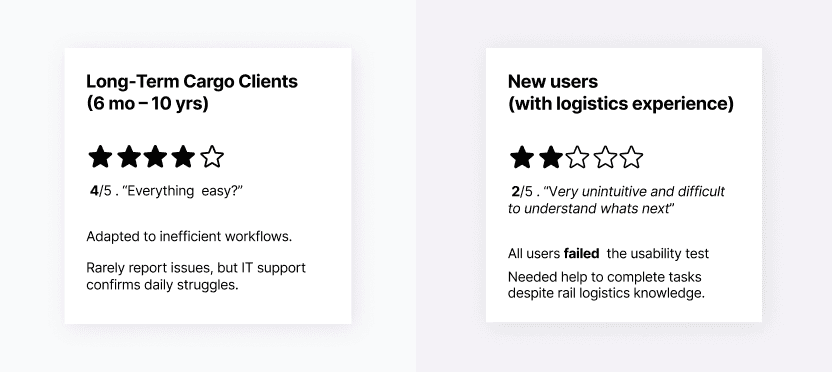
Loyal users adapted, but new users faced steep learning curves
This research validated audit insights and guided the redesign of a unified, simplified order form.
See the results of your interview
To understand how the internal Cargo system is used, I interviewed clients, internal teams, and developers, and conducted usability tests.
The goal was to uncover real frustrations and usability gaps between business logic and user behavior.
Methods
Clients: New and long-term LTG Cargo customers
Teams: IT, Support, and system developers
Testing: 4 logistics experts using New Order and Track Shipment flows
Findings
All test users struggled to complete tasks without help
Inconsistent fields and duplicate data entry caused confusion
Older users made repeated errors and relied on support
Loyal users adapted, but new users faced steep learning curves
This research validated audit insights and guided the redesign of a unified, simplified order form.
See the results of your interview
To understand how the internal Cargo system is used, I interviewed clients, internal teams, and developers, and conducted usability tests.
The goal was to uncover real frustrations and usability gaps between business logic and user behavior.
Methods
Clients: New and long-term LTG Cargo customers
Teams: IT, Support, and system developers
Testing: 4 logistics experts using New Order and Track Shipment flows
Findings
All test users struggled to complete tasks without help
Inconsistent fields and duplicate data entry caused confusion
Older users made repeated errors and relied on support
Loyal users adapted, but new users faced steep learning curves
This research validated audit insights and guided the redesign of a unified, simplified order form.
See the results of your interview
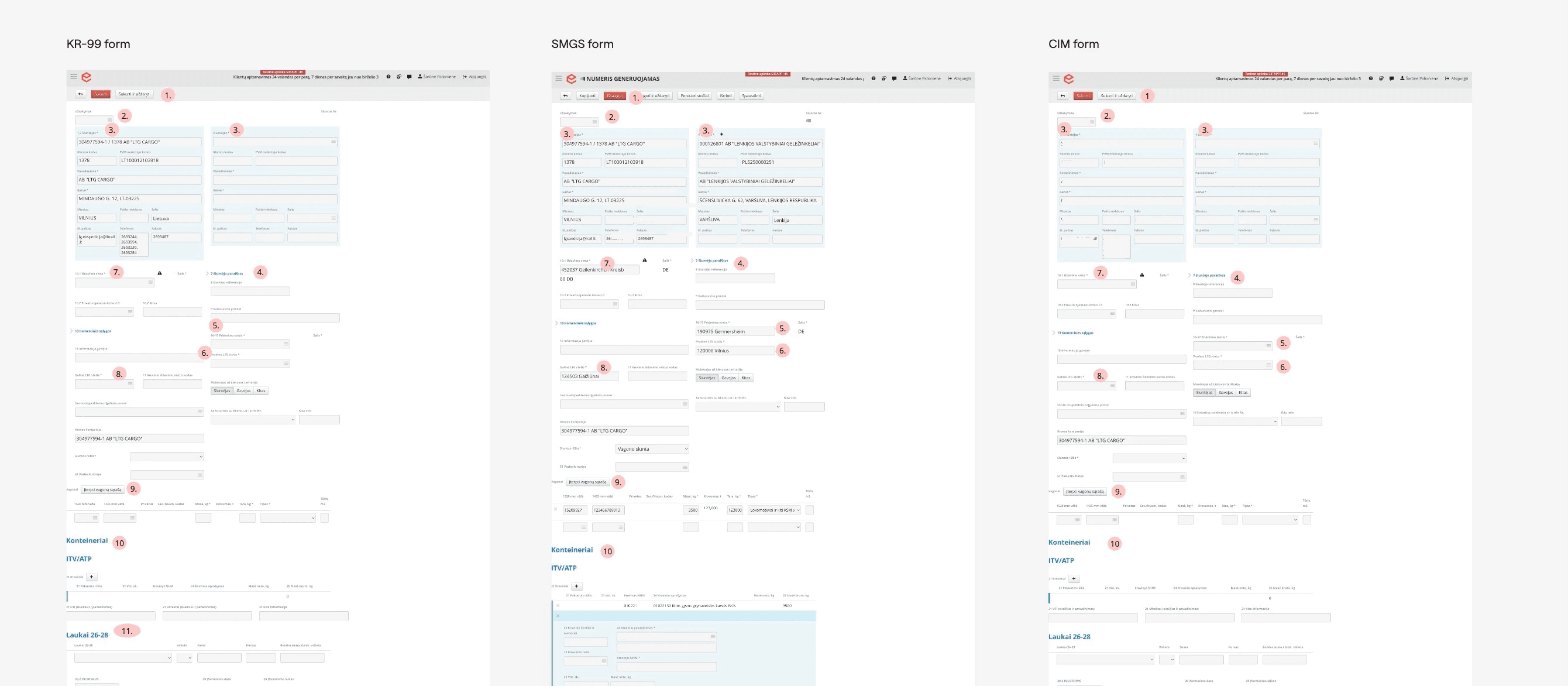
For example, inconsistent cargo order forms
Three separate order forms (KR-99, SMGS, and CIM) contained over ten unique input components that users had to fill repeatedly. These forms could be unified into a single, dynamic flow where shared data is entered once, and only case-specific fields appear as needed. View the full heuristics analysis table
Three separate order forms (KR-99, SMGS, and CIM) contained over ten unique input components that users had to fill repeatedly. These forms could be unified into a single, dynamic flow where shared data is entered once, and only case-specific fields appear as needed. View the full heuristics analysis table
Solutions & Recommendations
Based on the audit, I proposed a three-layered improvement plan:
Quick Wins: UI alignment, simplified form layouts, and clear CTAs for frequent actions.
Mid-Term: Navigation restructuring and onboarding pattern introduction.
Long-Term: Establishing a component library and improving hand-off between design and dev teams.
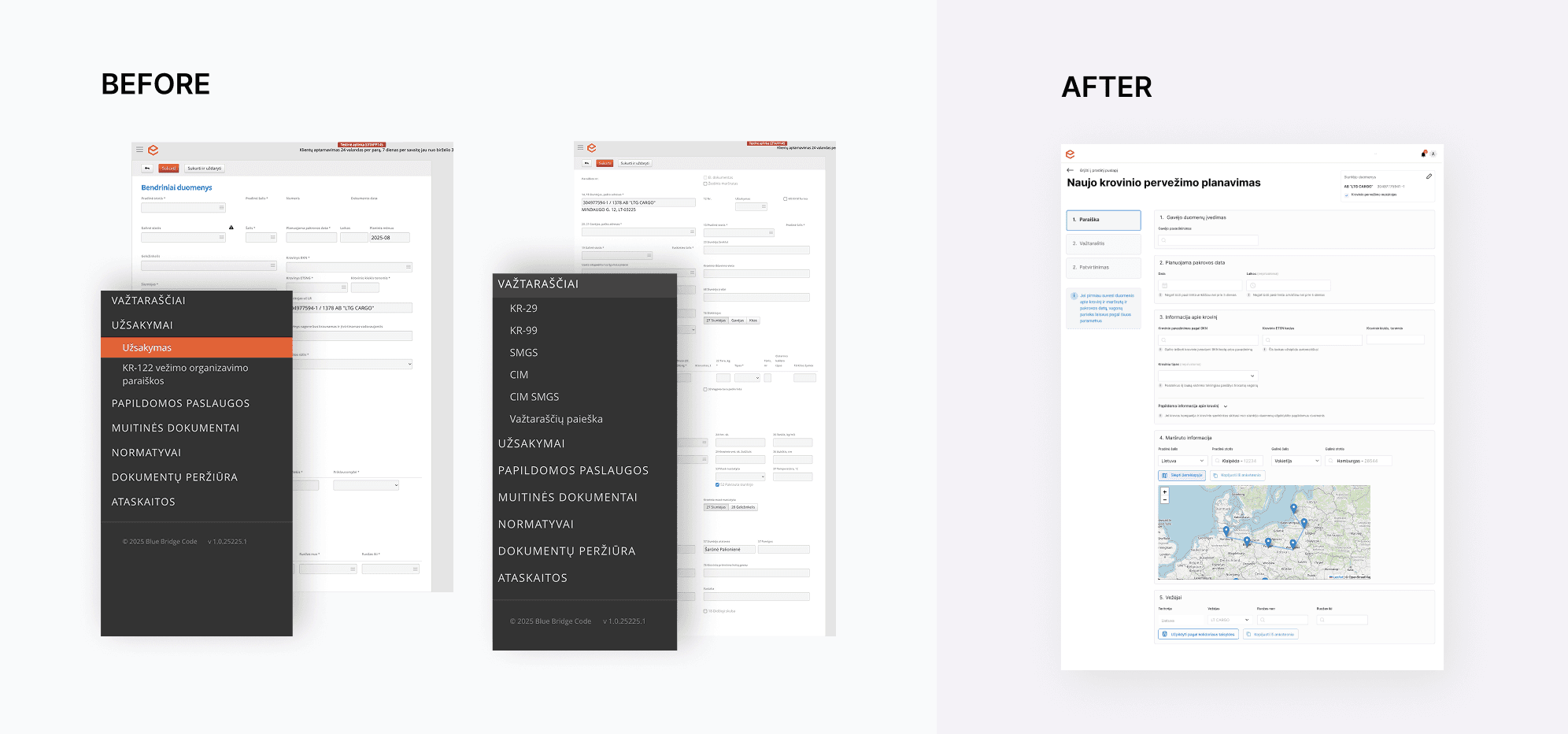
To illustrate potential improvements, I designed example screens showcasing the revised navigation and optimized shipment flow.
Based on the audit, I proposed a three-layered improvement plan:
Quick Wins: UI alignment, simplified form layouts, and clear CTAs for frequent actions.
Mid-Term: Navigation restructuring and onboarding pattern introduction.
Long-Term: Establishing a component library and improving hand-off between design and dev teams.
To illustrate potential improvements, I designed example screens showcasing the revised navigation and optimized shipment flow.
Component Standardization and Flow Optimization
The redesigned flow minimizes the number of input components and unifies all cargo types into a single request form.
Users now need to enter only five key inputs, after which the system automatically suggests the required documents and pre-fills relevant information — eliminating repetition and guesswork.
The redesigned flow minimizes the number of input components and unifies all cargo types into a single request form.
Users now need to enter only five key inputs, after which the system automatically suggests the required documents and pre-fills relevant information — eliminating repetition and guesswork.
Results
Results
The client received a detailed UX/UI audit report and a clear roadmap for improving their platform over the next six months.
The audit helped the product team identify high-impact areas for redesign and align stakeholders on design priorities.
Several quick-win improvements have already been implemented based on the recommendations.
The client received a detailed UX/UI audit report and a clear roadmap for improving their platform over the next six months.
The audit helped the product team identify high-impact areas for redesign and align stakeholders on design priorities.
Several quick-win improvements have already been implemented based on the recommendations.
What I learned
What I learned
This project reminded me how much impact a well-structured UX audit can have even without full user data.
I learned to prioritize findings by business impact and communicate design reasoning to non-design stakeholders in a concise, actionable format.
Next time, I would plan short usability tests early on to validate assumptions before the audit phase.
This project reminded me how much impact a well-structured UX audit can have even without full user data.
I learned to prioritize findings by business impact and communicate design reasoning to non-design stakeholders in a concise, actionable format.
Next time, I would plan short usability tests early on to validate assumptions before the audit phase.
Ready to improve your platform without starting from scratch?
Ready to improve your platform without starting from scratch?
Let’s collaborate — I help teams uncover UX issues and turn them into practical design opportunities.
Let’s collaborate — I help teams uncover UX issues and turn them into practical design opportunities.
Ready to kick off?
Ready to kick off?
Ready to kick off?